What’s New in LEED Version 5 About Indoor Air Quality?
January 7, 2025 | Fon Zhou
As global attention increasingly turns toward sustainable building practices, ensuring superior indoor air quality (IAQ) has become a critical focus. The latest version of the Leadership in Energy and Environmental Design (LEED v5) underscores this priority by introducing more rigorous IAQ standards and incentivizing advanced air cleaning technologies. AirQuality Technology’s Micro Electrostatic Precipitation (MESP) IAQ solutions align seamlessly with these new standards, offering a transformative approach to indoor air management.
Understanding LEED v5's Enhanced IAQ Requirements
LEED Version 5 (v5) introduces significant enhancements to indoor air quality (IAQ) standards, emphasizing continuous monitoring and proactive management to improve occupant health and comfort. Key updates include:
1. Continuous IAQ Monitoring Incentives: LEED v5 rewards projects that implement real-time IAQ monitoring systems. Up to 12 points can be earned by continuously tracking parameters such as CO₂, PM2.5, total volatile organic compounds (TVOCs), ozone, PM10, nitrogen dioxide (NO₂), and formaldehyde. This approach encourages ongoing assessment over periodic spot checks, promoting sustained air quality management.
2. Enhanced Ventilation and Filtration Standards: A new prerequisite requires projects to verify ventilation and filtration systems against benchmarks like ASHRAE Standard 62.1. While immediate corrective actions aren't mandated, identifying potential improvements is essential. The use of MERV 13 filters is recommended to enhance filtration efficiency.
3. Strategies for IAQ Improvement: LEED v5 offers additional points for implementing IAQ enhancement strategies, including:
- Increased Ventilation: Exceeding ASHRAE 62.1 requirements by increasing ventilation rates by at least 15% in occupied spaces.
- Infection Risk Management: Adhering to ASHRAE Standard 241's Infection Risk Management Mode to mitigate airborne health risks.
- Advanced Filtration: Installing filtration systems with a minimum MERV 13 rating to capture finer particulates.
- Operable Windows: Providing occupants with access to operable windows to enhance natural ventilation.
- Outdoor Air Quality Monitoring: Implementing systems to monitor outdoor air quality, informing indoor air management strategies.
These updates reflect LEED v5's commitment to advancing IAQ standards, promoting continuous monitoring, and encouraging proactive measures to ensure healthier indoor environments.
Optimal Indoor Air Quality Performance to Earn Points in LEED v5
PM2.5 Standards in LEED v5:
Measurement and Thresholds:
- Projects must measure PM2.5 levels continuously over a specified period (e.g., at least four consecutive months).
- To earn credits, PM2.5 levels must meet or improve upon the following thresholds: 1) Minimum Threshold: ≤ 12 µg/m³ (aligned with the World Health Organization or national standards); 2) Enhanced Threshold (optional, for additional points): ≤ 7 µg/m³.
Points Allocation:
- Meeting the minimum PM2.5 threshold earns 2 credits.
- Meeting the enhanced threshold can earn additional credits.
Filtration Requirements:
- The ventilation system must include air filters rated at least MERV 13 (or equivalent).
- Filtration must effectively capture fine particulate matter (PM2.5) from outdoor and recirculated air.
PM10 Standards in LEED v5:
Measurement and Thresholds:
- PM10 must also be measured during the same monitoring period as PM2.5.
- To earn credits, PM10 levels must meet these thresholds: 1) Minimum Threshold: ≤ 50 µg/m³ (24-hour average); 2) Enhanced Threshold: ≤ 25 µg/m³.
Points Allocation:
- Meeting the minimum PM10 threshold earns 1 credit.
- Meeting the enhanced threshold can earn additional points.
Ventilation and Control Measures:
Implement systems or strategies to minimize the infiltration of PM10 particles into the building, such as:
- Proper sealing of entryways.
- Use of entryway mats to capture particulates.
- Positive pressurization in spaces prone to particulate ingress.
Complying with ASHRAE Standard 24
In LEED v5, there are a few ways to earn points for complying with ASHRAE 241, Control of Infectious Aerosols.
- EQ Credit: Resilient Spaces (1 point): Projects can earn 1 point for designing occupied spaces with the capability to operate an Infection Risk Management mode that provides the minimum equivalent clean airflow rates outlined in ASHRAE 241. nbsp;
- EQ Prerequisite: Fundamental Air Quality (1 point): If using stand-alone in-room air cleaning systems, they must be tested for effectiveness and safety per ASHRAE Standard 241. nbsp; Sources and related content
Energy Saving in Air Filtration Section in LEED v5
In LEED Version 5, the Energy Saving in Air Filtration section is addressed as part of optimizing indoor air quality (IAQ) while maintaining energy efficiency. Since air filtration can significantly impact energy consumption due to fan power requirements, LEED promotes strategies that balance high IAQ with reduced energy use.
Here's how energy savings in air filtration are incorporated:
1. Efficient Filtration Standards
- Objective: Improve IAQ without excessive energy penalties from filtration systems.
- Key Strategies: Use filters with high efficiency (e.g., MERV 13 or higher) that are also designed for low-pressure drops; Select filters with low resistance to airflow to minimize the energy required for fan operation.
- Energy-Saving Benefits: Reduces HVAC system energy consumption by decreasing the load on fans; Ensures optimal airflow while maintaining filtration efficiency.
2. Advanced Filtration Technologies
- Objective: Leverage innovative air cleaning technologies that enhance IAQ without high energy costs.
- Examples:Electronic Air Cleaners (EAC): Use electrostatic precipitation to capture particles, offering a lower-pressure drop compared to traditional media filters.
- Hybrid Systems: Combine HEPA filters with energy recovery ventilators (ERVs) to offset energy costs while maintaining superior IAQ.
- Energy-Saving Benefits: Reduces energy penalties associated with frequent filter changes or high resistance filters. Maintains high IAQ performance with lower energy input.
3. Variable Air Volume (VAV) Systems with Demand Control Ventilation (DCV)
4. Efficient Fan Systems
5. Filter Maintenance and Monitoring
6. Integration with Energy Recovery Systems
Credit Opportunities of Energy Saving in LEED Version 5
These strategies contribute to both Energy and Atmosphere (EA) and Indoor Environmental Quality (IEQ) categories:
- EA: Optimize Energy Performance (Up to 20 points).
- IEQ: Enhanced Indoor Air Quality Strategies (Up to 5 points).
AirQuality Technology's MESP: A LEED-Ready Solution
AirQuality Technology’s patented MESP solutions redefine how IAQ challenges are addressed. These systems excel in performance, energy efficiency, and environmental sustainability, making them ideal for projects aiming to achieve LEED certification under v5.
1. Advanced Filtration Technology
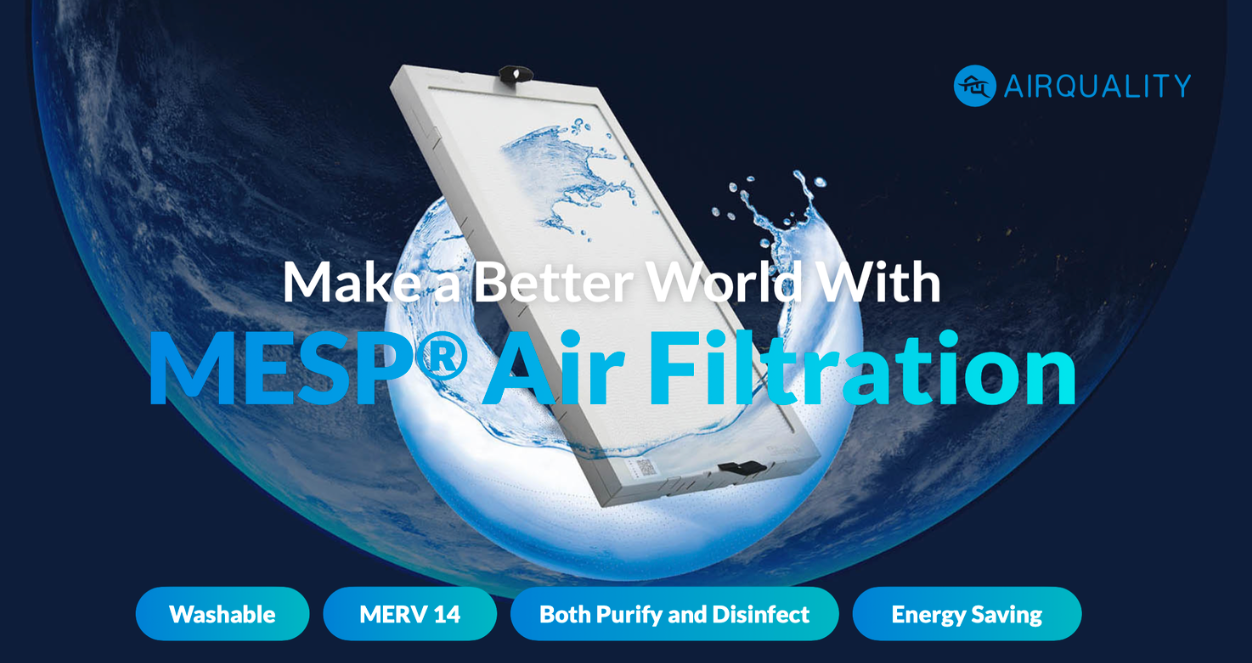
MESP systems employ cutting-edge electronic air cleaning technology to effectively remove particulates, including PM2.5 and ultrafine particles, surpassing traditional filtration methods. With a filtration efficiency equivalent to MERV 14 standards, MESP ensures compliance with LEED v5 requirements.
2. Washable Filter
MESP includes a highly durable, washable filter, which provides significant cost savings over time and supports sustainable building practices. This feature reduces the need for frequent filter replacements, promoting long-term environmental and operational efficiency.
3. Real-Time Monitoring and Integration
MESP units integrate seamlessly with building automation systems, providing continuous monitoring and reporting of key IAQ metrics such as CO₂, particulate matter, and VOC levels. This feature supports the 12-point incentive for IAQ monitoring in LEED v5.
4. Sustainable and Energy-Efficient Design
Unlike conventional filtration systems, MESP technology minimizes pressure drop, significantly reducing energy consumption. By lowering HVAC system loads, MESP contributes to both operational cost savings and improved building sustainability, aligning with LEED’s energy efficiency goals.
5. Infection Risk Management
MESP solutions include advanced disinfection capabilities, effectively neutralizing airborne pathogens. These systems meet ASHRAE Standard 241 requirements, providing robust infection risk management in high-occupancy settings like schools, offices, and hospitals.
6. Modular and Customizable Implementation
MESP units are modular, enabling tailored solutions for diverse building needs. Their compact design allows for easy retrofitting in existing HVAC systems, ensuring minimal disruption during installation.
The Competitive Advantage: Why Choose MESP for LEED v5 Projects?
By incorporating MESP technology into building designs, developers and facility managers can unlock several advantages:
- Maximized LEED v5 Points: MESP supports compliance across multiple IAQ criteria, ensuring projects achieve higher certification levels.
- Enhanced Occupant Health and Comfort: Superior air quality directly improves occupant well-being and productivity.
- Cost-Effective Sustainability: Energy-efficient operations reduce long-term costs while meeting environmental goals.
- Future-Proofed Infrastructure: With scalable and adaptable solutions, MESP prepares buildings for evolving IAQ standards.
Case Studies: Success Stories with MESP
A high-rise in Shanghai integrated MESP systems into its HVAC design, achieving a 25% reduction in energy costs while maintaining LEED Gold certification.
Conclusion: Leading the Way in Sustainable IAQ
As LEED v5 raises the bar for indoor air quality, AirQuality Technology’s MESP solutions provide a proven, future-ready path to compliance. Combining cutting-edge filtration, energy efficiency, and real-time monitoring, MESP not only meets but exceeds the standards set by LEED v5.
For more information on how AirQuality Technology can help your projects achieve superior IAQ and LEED certification, contact us and revolutionize your building’s air quality.
For more information about MESP IAQ solution, please visit our website.