Преимущества технологии MESP по сравнению с другими основными методами стерилизации воздуха
November 21, 2021 | M. Nassir

With the epidemic spreading all over the world, people's demand for indoor air quality has changed from simple fine particles PM2.5 removal to removing both PM2.5 and microorganisms (bacteria/viruses) in the air.
In the air, biological pollutants such as bacteria and viruses are dispersed particles with very small diameter, their sedimentation rate can be ignored. These biological pollutants can be considered as a kind of biological aerosol. In polluted air, aerosol refers to solid particles, liquid particles or suspension of solid particles in gas medium with negligible sedimentation velocity. Aerosols with a diameter of 0.1 μm to 10 μm in indoor air pollutants can be called inhalable particles. Inhalable particulate matter is considered as the most harmful to human body, especially the part with a diameter of less than 2.5 microns. The particle diameters of bacteria and viruses are within this range. Coupled with their possible pathogenic factors, they pose a greater threat to human health.
What are the advantages of disinfection by air purification devices? It has been proved that bacteria are attached to dust particles so they are the carrier of bacteria, it is like the attachment between skin and hair. Therefore, sterilization is not complete unless it is done together with dust removal. Common disinfection methods such as UV irradiation and aerosol spraying do not have dust removal effect. Many bacteria and other microorganisms in the air adhere to the dust particles and settle on the floor and desktop or adsorbed on the wall and ceiling. It may seem that the total number of bacteria in the air has decreased, but actually they are still dormant indoors. Once slight movement is involved, bacteria will fly again with the dust and return to the air.
What are the conventional air disinfection techniques? What are the advantages and disadvantages?
1. HEPA: high dust removal efficiency, but can not kill bacteria and viruses.
2. UV: the disinfection efficiency of the object surface is high, but it cannot effectively disinfect the flowing air. Therefore, it is generally used to disinfect the filters rather than the air.
3. Ozone: it can effectively sterilize and disinfect, but it cannot be used with other people around due to high ozone concentration that is harmful to human health.
4. Electrostatic ESP: it can remove particles and sterilize, but the ozone often exceeds the standard.
5. Photocatalyst: it can sterilize the air without removing particles.
6. Plasma: it can sterilize and disinfect the air, but the function of removing particles is very weak. It depends on ion wrapping particles and natural sedimentation after increasing the particle size to achieve the effect of removing suspended particles in the air.
7. Bipolar ionization: similar to plasma.
8. Air disinfectant: 0.2% Peracetic acid or 3% Hydrogen peroxide;
- Disinfectant cannot be used for air disinfection. Irrelevant personnel shall be evacuated from the site during disinfection;
- This kind of disinfectant is toxic to people and irritating to skin, mucous membrane and eyes. Pay attention to personal protection especially wear protective masks, protective glasses and protective gloves during use, and use comprehensive respiratory protectors when necessary. In case of accidental contact, wash it continuously with water and seek medical advice as soon as possible in case of serious cases.
- During air disinfection, doors and windows shall be closed. After disinfection, people can enter only when the indoor disinfectant is reduced to acceptable standard. When conditions permit, windows can be opened for ventilation to make the disinfectant diffuse and neutralize as soon as possible.
9. Negative ions: the function of sterilization or particle removal is very weak.
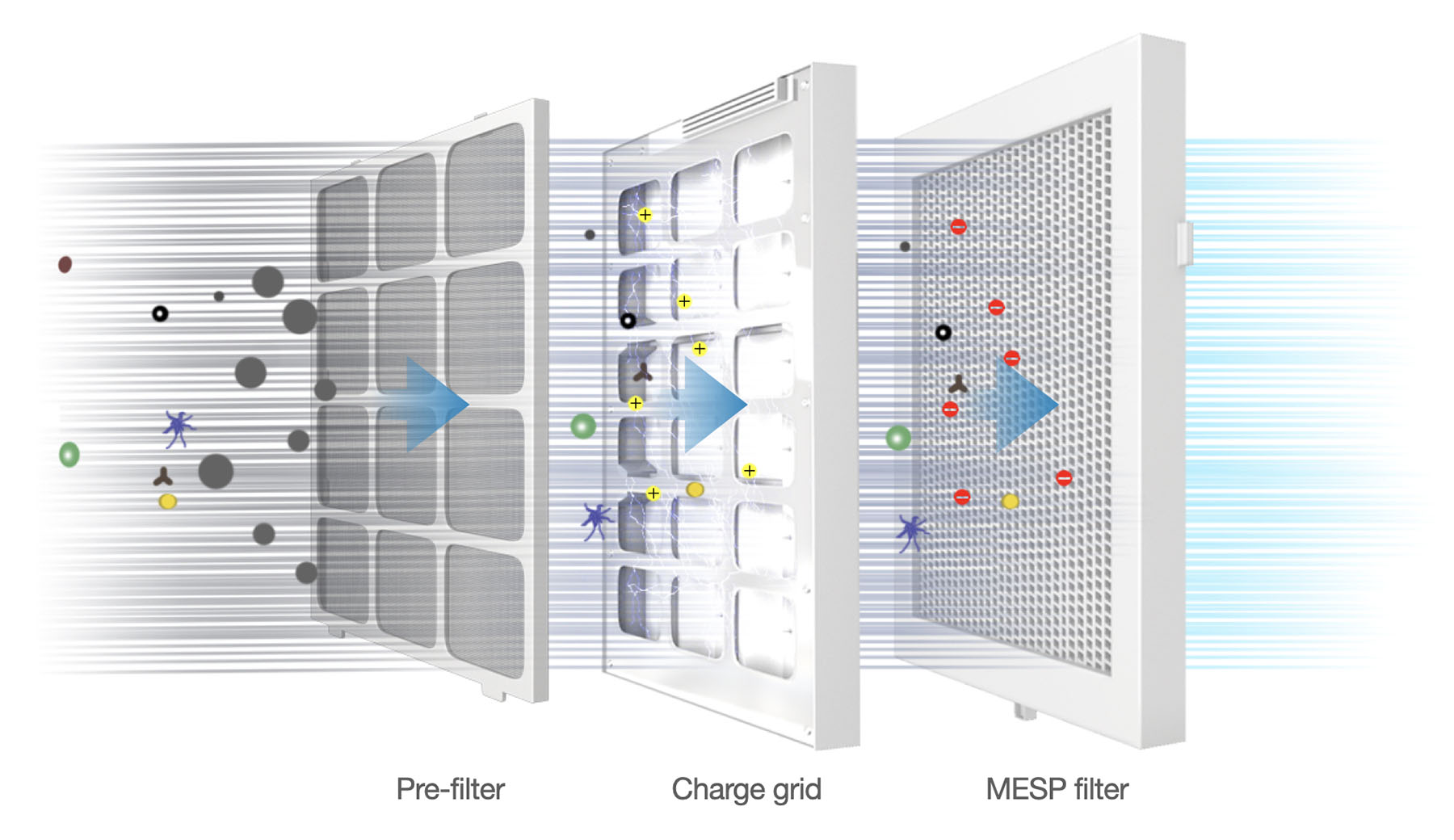
По сравнению с вышеперечисленными технологиями дезинфекции воздуха, MESP является более комплексной и безопасной технологией.
•Удаление частиц из воздуха в помещении и бактерицидное/уничтожающее вирусы действие (тест, проведенный в американской независимой лаборатории, показал, что уровень уничтожения MESP против COVID-19 составил 99,99%)
•Фильтры можно мыть и использовать повторно, а расчетный срок службы составляет до 10 лет (лабораторное испытание AQT показывает, что эффективность сбора пыли фильтрами MESP снижается всего на 1,3% после 100 промываний)
•Низкое энергопотребление, низкое сопротивление ветру, энергосбережение и экологичность
•Безопасность и практически отсутствие образования озона
•Отсутствие дуги и искр
•Можно использовать, когда рядом находятся люди (сосуществование с людьми)
•Адаптация к различным условиям окружающей среды, таким как высокая/низкая температура и высокая влажность
•Простая установка и обслуживание
Если вы хотите запросить дополнительную информацию, не стесняйтесь обращаться к своему торговому представителю в AQT или напрямую отправлять электронное письмо с вашим запросом на адрес partner@airquality.com. Более подробную информацию также можно найти на нашем веб-сайте: www.airquality.com